
The Full Story
Riparian Buffer Restoration

Overview
At Wai & Aina, one of our long-term conservation goals is to restore the stream corridor running through our farm. When we arrived, much of the watershed edge had been cleared of trees for former cattle pasture and overtaken by guinea grass and invasive weeds. In sunny, wet areas, guinea grass grows extremely fast and can completely dominate streambanks, making it harder for native plants, wildlife habitat, and healthy stream flow to return.
Our restoration design is inspired by the USDA NRCS Riparian Forest Buffer conservation practice, Code 391, which uses trees, shrubs, and groundcover along waterways to protect water quality, stabilize soil, and create habitat. Because our planted corridor is often closer to 10–20 feet wide rather than a full riparian forest buffer width, the NRCS-funded practice we are implementing is officially Tree/Shrub Establishment, Code 612, supported by Tree/Shrub Site Preparation, Code 490, and Mulching, Code 484. The concept is still rooted in riparian restoration: bringing trees back to the water’s edge, improving soil stability, and eventually buffering livestock away from the stream.
How We Implement It
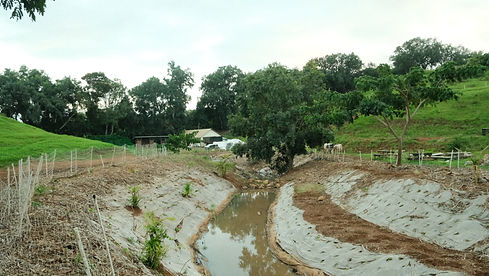
This is one of our biggest restoration projects. From 2024–2026, we completed roughly the first 25% of the stream corridor by reshaping banks, removing invasive grass, preparing planting areas, and installing erosion-control materials. Because weeds grow so aggressively in Kauaʻi’s climate, we went beyond mulching only around tree bases and instead mulched and jute-netted larger areas of exposed soil.
Our cows, goats, and sheep initially helped graze down tall guinea grass so it was easier to remove manually. Long term, the goal is to fence livestock out of the stream corridor so trees, shrubs, and groundcover can protect the banks and reduce manure contamination in the water.
Through NRCS, we were awarded support for approximately 200 shrubs and 200 trees, with a goal that about half of the plantings across the buffer will be native species.

What’s Next
The remaining 75% of the stream corridor still needs restoration work, including soil stabilization, grading plans, stream crossings, and natural stream-habitat design with riffles, runs, and pond areas. We are also working with neighbors, arborists, volunteers, and community members to source more plants for the corridor, sometimes through creative trades like milk exchanges.
Our hope is to complete the major planting and restoration work by 2028. There have been real-world delays from livestock, fencing, weather, and invasive weeds — in 2025, many of our young trees were eaten or trampled after goats and cows broke through fencing. We are now focusing more heavily on groundcover, protection, and resilient establishment strategies.
Long-Term Vision
We envision this stream corridor becoming an educational riparian buffer with native and food-producing trees, wildlife habitat, walking paths, signage, and gathering areas where visitors, students, and volunteers can learn about watershed health, erosion control, native plants, livestock management, and regenerative agriculture.
We are actively seeking funding, nonprofit grants, plant donations, volunteer help, and community partnerships to support the next phase of this living watershed classroom.
Our cows, goats, and sheep initially helped graze down tall guinea grass so it was easier to remove manually. Long term, the goal is to fence livestock out of the stream corridor so trees, shrubs, and groundcover can protect the banks and reduce manure contamination in the water.
Through NRCS, we were awarded support for approximately 200 shrubs and 200 trees, with a goal that about half of the plantings across the buffer will be native species.
