

Conservation Projects
Explore the land stewardship projects helping Wai & ʻĀina restore stream corridors, grow food, care for livestock, and build a more resilient farm system.

Restoration plantings along the stream help create a living riparian buffer, reducing erosion and supporting healthier water, soil, and wildlife habitat over time.
Restoration plantings along the stream help create a living riparian buffer, reducing erosion and supporting healthier water, soil, and wildlife habitat over time.
Riparian Buffer Restoration
A riparian buffer is a planted area along a stream or waterway that helps protect the land and water around it. At Wai & ʻĀina, this project is restoring nearly 1,000 feet of stream corridor with around 400 native and productive trees and shrubs. These plantings help reduce erosion, filter runoff, shade the water, create wildlife habitat, and form a living buffer between livestock areas and the stream.
Related NRCS practices: Riparian Forest Buffer — Code 391; Tree/Shrub Establishment — Code 612; Tree/Shrub Site Preparation — Code 490; Mulching — Code 484; On-Farm Secondary Containment Facility - 319
Agroforest & Orchard
This project blends orchard design with agroforestry to create a productive, educational food-growing system. Traditional orchard spacing allows room for access, gathering, and learning, while denser agroforest plantings demonstrate long-term fruit production. Nitrogen-fixing perennial peanut grass helps cover and enrich the soil, while bananas, papayas, fruit trees, chickens, and mini sheep help manage weeds and cycle nutrients.
Related NRCS practices: Forest Farming — Code 379; Conservation Cover — Code 327.
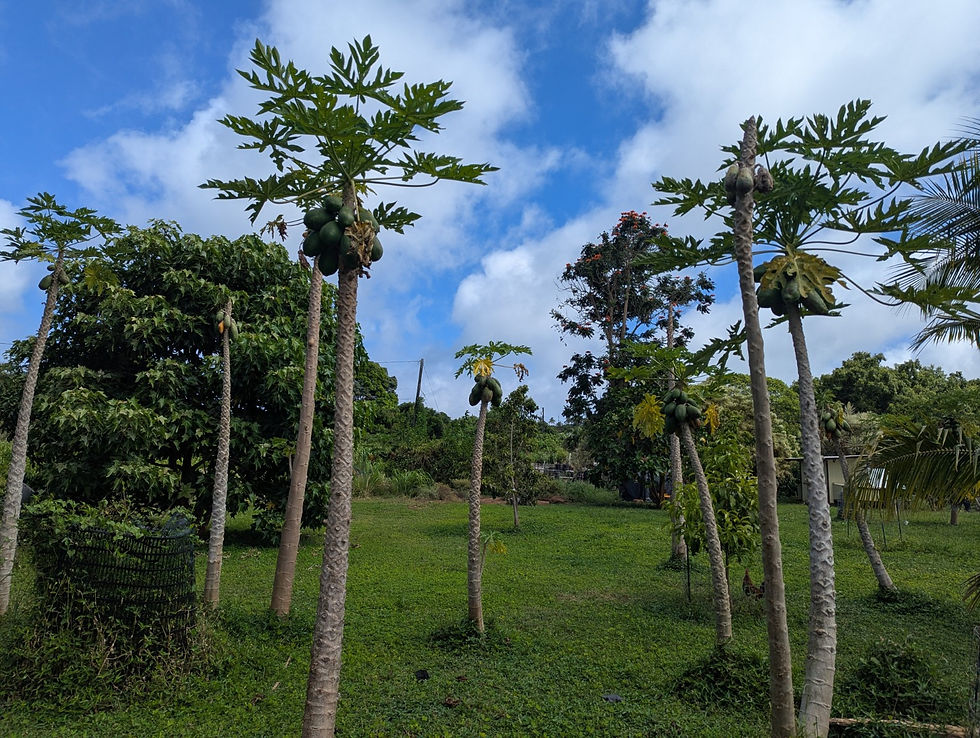
Papaya and other productive trees grow together in Wai & ʻĀina’s agroforestry and orchard system, where layered plantings support food production, soil cover, and long-term land stewardship.
Papaya and other productive trees grow together in Wai & ʻĀina’s agroforestry and orchard system, where layered plantings support food production, soil cover, and long-term land stewardship.


Rotational grazing moves livestock through the landscape in planned cycles, allowing pasture areas to recover while animals help manage vegetation and return nutrients to the soil.

Eros grazes with a NoFence virtual fencing collar, allowing Wai & ʻĀina to manage livestock movement while giving pasture areas time to rest and recover.
Rotational Grazing with Crossfencing & NoFence
Rotational grazing uses planned animal movement to manage pasture, reduce overgrazing, and give plants time to recover. At Wai & ʻĀina, NoFence virtual fencing helps guide livestock through different areas of the farm without permanent fence lines. This supports healthier forage, natural nutrient cycling, and protection for sensitive areas like young plantings, stream edges, and restoration zones.
Related NRCS practice: Fence — Code 382; Prescribed Grazing — Code 528
Silvopasture
Silvopasture brings trees, forage plants, and grazing animals together in one managed system. At Wai & ʻĀina, koa and mahogany trees are part of this long-term approach, adding shade, structure, and ecological value to the pasture landscape. By combining trees with planned grazing, this practice can improve animal comfort, build healthier soil, reduce weed pressure, and create a more diverse farm system where animals and trees support the land together.
Related NRCS practice: Silvopasture — Code 381.


Raincatchment &
Livestock Pipeline
Raincatchment and livestock pipeline systems help make farm water use more reliable and efficient. By collecting rainwater and moving water to where animals need it, this project supports healthier grazing management, reduces pressure on shared water sources, and helps care for livestock across different areas of the farm.
Related NRCS practice: Livestock Pipeline — Code 516; Water Harvesting Catchment — Code 636
Stream Crossing
A stream crossing provides a stable, designated place for people, equipment, or livestock to cross a waterway while reducing damage to the streambank. Instead of repeated crossing in sensitive areas, a planned stream crossing helps limit erosion, protect water quality, and keep movement across the farm safer and more intentional. At Wai & ʻĀina, this practice supports both daily farm access and the long-term health of the stream corridor.
Related NRCS practices: Stream Crossing — Code 578


Solar Energy Projects
Solar energy helps Wai & ʻĀina build a more resilient and self-sufficient farm system. Current and planned projects include a 9,600W solar carport, a 4,800W retrofit of an older system, and additional off-grid solar setups designed to power farm needs across the property. Supported through USDA REAP and farm investment, these projects reduce reliance on outside energy sources while preparing the farm for more electric vehicles and custom-designed electric UTVs.